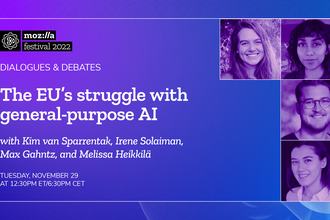
It might appear that we’re at an impasse when it comes to regulating foundation models in the AI Act — in fact, this could put the entire AI Act at risk. But we believe there’s a middle ground for all sides to come to an agreement.
This month’s Dialogues and Debate series will explore what effective regulation of “general-purpose AI” could look like in the EU and who needs to be held accountable.
Mozilla research found that detection tools aren’t always as reliable as they say. Further, researchers found that large language models like ChatGPT can be successfully prompted to create more ‘human-sounding’ text
Mozilla’s latest round of Creative Media Awards will provide $245,000 in funding to Black artists who are exploring the effects of AI on racial justice

Author Min’enhle Ncube is an anthropologist and Mozilla Africa Mradi Research Grantee. Ncube is investigating the challenges and dangers posed by biased datasets in the delivery of quality and timely care to pregnant people
In this explainer, we tackle one of the most basic questions: What are some of the key moments of human decision-making in the development of generative AI products? This question forms the basis of our current research investigation at Mozilla to better understand the motivations and values that guide this development process.
Troch
Maximilian Gahntz,
Mark Surman,
Mozilla Insights
April 25, 2022
Members of the European Parliament leading on the AI Act in the internal market (IMCO) and civil liberties (LIBE) committees have published a landmark report on what direction they want the Act to take. With this report in hand, parliamentarians will negotiate their joint position as well as their vision of what exactly “Trustworthy AI” means to the EU.